I used to think 'Beauty is a big business' was a phrase that people often repeat because it seems obvious. And sometimes, when we repeat a phrase too often, the phrase loses the impact it used to possess.
That's the reason why I started looking at the numbers so the phrase can have its impact back in my mind. The personal care & beauty market is projected to have $698.38 billion in revenue in 2026.
According to the beauty industry statistics that I'm going to share, this projected market research is just the beginning. So, let's start the journey to finding the real meaning of 'Beauty is a big business.'
How Big is the Beauty Business, Really?
Statista states the Beauty & Self-care business is projected to grow to $698.38 billion in terms of revenue in 2026. But there isn't one universally accepted number for the size of the beauty industry.
The statement will make sense when you look at how different research firms define "beauty." Statista's definition of the beauty business is broad, and McKinsey's core beauty market is narrower.
Individual companies such as L'Oréal also use their own market definitions when reporting their competitive position. That is why the numbers below should be read with their methodology in mind.
1. Beauty & Personal Care is projected to generate $698.38 billion in 2026
Statista estimates worldwide Beauty & Personal Care revenue will reach $698.38 billion at a 3.16% compound annual growth rate from 2026 to 2031.
That's the number that made me stop thinking about beauty as simply a collection of cosmetics brands. We're talking about an industry approaching $700 billion in annual consumer spending.
And that's before considering beauty services, salons, and several adjacent markets that aren't included in the same definition.
2. McKinsey expects the core beauty market to grow about 5% annually through 2030
McKinsey has produced a more aggressive forecast with a rough 5% annual growth rate of the beauty market through 2030.
McKinsey's research highlights a new revenue possibility compared to Statista's. These stats taught me something very important. When someone says, “the beauty market is worth X,” the next question should be: Which beauty market?
Because definition matters.
What People Are Buying from the Beauty Market
The next question was more interesting to me: If beauty is nearly a $700 billion market, where is all that money going?
You shouldn't be surprised that the answer is not evenly distributed. In different places, there will be different uses of self-care & beauty products. But if I talk about the distribution of each type of beauty product in the market, then:
Skincare dominates. Haircare remains enormous. Makeup is important but faces a different growth trajectory. And fragrance is quietly becoming one of the industry's most interesting stories.
1. Skincare accounts for 39% of the global beauty market
L'Oréal's 2025 beauty-market analysis states that skincare represented 39% of the global beauty market.
That puts skincare comfortably ahead of the other major categories. Haircare represented 21%, makeup 16%, fragrance 14%, and hygiene 10%.
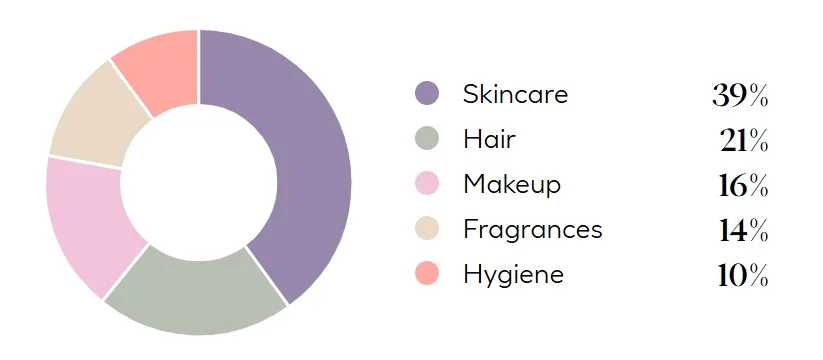
So nearly four out of every ten dollars in this particular market breakdown goes toward skincare.
That explains: "The obsession with serums, treatments, routines, and skin health look is not just a social media fad."
2. The skincare market is projected to reach about $204 billion in 2026
Statista projects global skincare revenue at approximately $204 billion in 2026. Just think about this number for a moment. A single beauty category is generating more than $200 billion in annual revenue.
One must consider the advantage of skincare: routines create repeat purchases, which help retain consumers.
For instance, a customer may replace the beauty foundation after a few months, but a cleanser, moisturizer, or serum can become part of a recurring routine. That makes skincare strategically valuable to brands.
3. Fragrance is expected to overtake color cosmetics by 2030 with a +5% annual growth rate
Fragrance is something we shouldn't underrate, as the McKinsey report shows that fragrance is going to overtake color cosmetics and will become the third-largest beauty category by 2030.
On the other hand, Circana reported that prestige fragrance sales in the United States increased +5% during the first half of 2025, while prestige makeup grew 1% and prestige skincare declined 1%.
Fragrance appears to be doing something particularly useful in a cautious consumer economy: It gives people an accessible way to buy into prestige.
The Beauty Store is No Longer A Single Store
After finding out where all that money is going, I was curious to know where these products were being purchased. That's where the definition of a beauty retailer starts to get confusing.
Here is a list of stores where I found beauty & self-care products:
A Sephora store
Amazon
Any brand's website
TikTok shops & TikTok videos (influencer marketing)
Instagram videos & reels (influencer marketing)
1. Online channels are projected to generate 30.6% of global Beauty & Personal Care revenue in 2026
I am personally satisfied with Beauty Matter's report that states beauty product sales are going to rise 10% because e-commerce, AI, and social commerce channels are being introduced in the beauty market in 2026.
In the same context, Statista estimates that 30.6% of worldwide Beauty & Personal Care revenue will come through online channels in 2026. That's almost one-third of the entire beauty market.
Such statistics are enough to prove that e-commerce isn't just a "digital side" of beauty, but a part of beauty retail.
2. McKinsey puts e-commerce at 28% of global beauty sales
According to McKinsey's beauty trends and stats, e-commerce represents 28% of global beauty sales by channel. The exact percentages differ because the research firms use different methodologies, as I've mentioned earlier.
But the underlying conclusion is difficult to miss: A huge portion of beauty shopping now happens online.
3. L'Oréal's e-commerce business has passed 30% of sales
The individual beauty brand, L'Oréal, has reported that e-commerce accounted for 30% of its sales in 2025.
This particular statistic is worth noting because L'Oréal isn't a digital-native startup, but it is earning 30% from the online world.
As we are discussing the giant beauty brands and their operations, there is a lesson for smaller brands: consumers don't think of online shopping as a separate beauty experience anymore.
Social Media Blurred the Line Between Marketing and Commerce
In the very beginning of marketing, marketers used to explain the customer journey as if it were a neat sequence: Awareness → consideration → purchase.
They used to configure a sales funnel for a brand. First, they would start spreading the word about the brand, then influence them with multiple strategies, and then they could convert a visitor into a customer.
And on social media, social commerce is making those stages happen in the same place. Someone watches a creator who is demonstrating a beauty product. They become curious, read comments, and witness another creator using the same product.
Then they buy it.
The "advertisement" and the "store" can effectively become the same piece of content on social media. I personally suggest that small and medium-sized beauty businesses invest in social commerce to get the maximum ROI.
1. Beauty generated approximately $2.08 billion in United States TikTok Shop sales
After the launch of TikTok Shop, the United States Beauty & Personal Care sales reached approximately $2.08 billion in 2025, according to WWD.
That's an extraordinary number for a platform that was originally understood primarily as an entertainment and discovery network. TikTok users, whether Gen Z or Millennials, know how to reward the brand that shows credibility and expertise.
2. TikTok Shop sold around 147 million beauty items in the United States in 2025
Approximately 147 million beauty items were sold with an average price of $18.57 through the United States TikTok Shop during 2025.
These stats showcase that this isn't just about awareness; it reflects real transaction volume. And beauty happens to be exceptionally well suited to short-form video because products can be demonstrated visually.
When users observe the product right in front of them, they will tend to watch it. They read others' opinions and reviews in the comment section, and they tend to be converted into loyal customers.
3. Skincare generated roughly $714 million in U.S. TikTok Shop sales
Skincare generated approximately $714 million in Q1 TikTok Shop sales in 2025, according to Beauty Independent. Makeup followed at approximately $642 million, while fragrance generated around $452 million.
These stats indicate the real power of skincare tutorial videos on TikTok, which are especially curated for calculated customers. Skincare tutorials on any social media platform, like Facebook and Instagram, aren't merely content; they're customer-generating tools.
Then I Started Looking at the People Selling Beauty
At the start, selling a product was never that hard because there was very low competition everywhere. If people thought of buying something, they didn't have to think about which brand would suit them or what product type would meet their goals.
Selling used to be relatively straightforward at that time:
Make a product.
Put it on shelves.
Advertise it.
But now there is another layer that you need to consider because of massive market competition. A brand should have people who can make customers care about the product.
That's where creators & sellers enter the story.
1. The global creator economy is projected to reach $310.4 billion in 2026
The creator market was $252.3 billion in 2025, and it is going to achieve the milestone of $310.4 billion by 2026. According to the Grand View Research report, the creator market is going to expand at a compound annual growth rate of 23.3% from 2026 to 2033.
These numbers cover a broader community of creators rather than beauty alone, but beauty is particularly dependent on creators because this category is heavily visual, demonstrable, and experiential.
What a creator can do for the beauty industry:
Show how a foundation looks
Demonstrate a skincare routine
Compare fragrances
Explain how a product fits into their life
Such marketing approaches are very different from traditional banner advertisements that people see and forget.
2. 83% of Gen Z women in one survey had purchased beauty products online because of creator recommendations
83% of Gen Z women in the United States are obsessed with content creators, and they have bought beauty and self-care products based on their recommendations, according to Statista.
That's the power of influencer marketing at work. Here, beauty businesses need to understand that influencer marketing should be used like retail infrastructure.
Further, they need to understand that a creator doesn't necessarily have to convince someone to love a brand and contribute to its sales. But they have the power to convince them to try the product at least once.
Gen Z Didn't Just Enter Beauty. It Changed the Conversation.
When we talk about the creators who make customers care about the product, we have to decide who is actually paying or spending the money on beauty products.
The answer isn't simply "women" because of all the stereotypes alongside gender. Different generations spend differently, discover products differently, and define beauty differently.
1. 96% of Gen Z consumers surveyed had purchased skincare
In July 2025, Vogue Business reported that 96% of Gen Z consumers surveyed had purchased at least one skincare product during the previous six months.
That is an almost universal penetration rate within the surveyed group. And it helps explain why skincare has become so deeply embedded in younger consumers' beauty routines.
Once again, these stats have proved that skincare is generating four out of every 10 dollars that the beauty market generates.
2. Gen Z households accounted for 38% of fragrance spending in a recent 26-week period
Gen Z households are responsible for 38% of fragrance spending during a recent 26-week period, according to Circana data reported by Reuters.
After skincare products, fragrance spending is worth watching because Gen Z households are obsessed with sweet aromas. That's a reason why younger consumers are not waiting to become participants in prestige beauty.
They are just buying beauty products that feel attainable and that help them enter the door of prestige beauty.
The Beauty Market is Also Moving Geographically
Another assumption I had to abandon was that beauty innovation simply moved from the United States and Europe outward.
However, the modern beauty ecosystem is much more complicated, as K-beauty has become a global export phenomenon and India represents a major emerging consumer market.
On the other hand, Asia-Pacific is not simply a manufacturing base, but it is one of the industry's most important sources of consumers, brands, and trends.
1. North America represents 28% of the global beauty market
L'Oréal has broken down the beauty market by category. That report also shows that North America represented 28% of the global beauty market in 2025.
North Asia followed at 27%, Europe at 24%, SAPMENA-SSA at 12%, and Latin America at 9%.
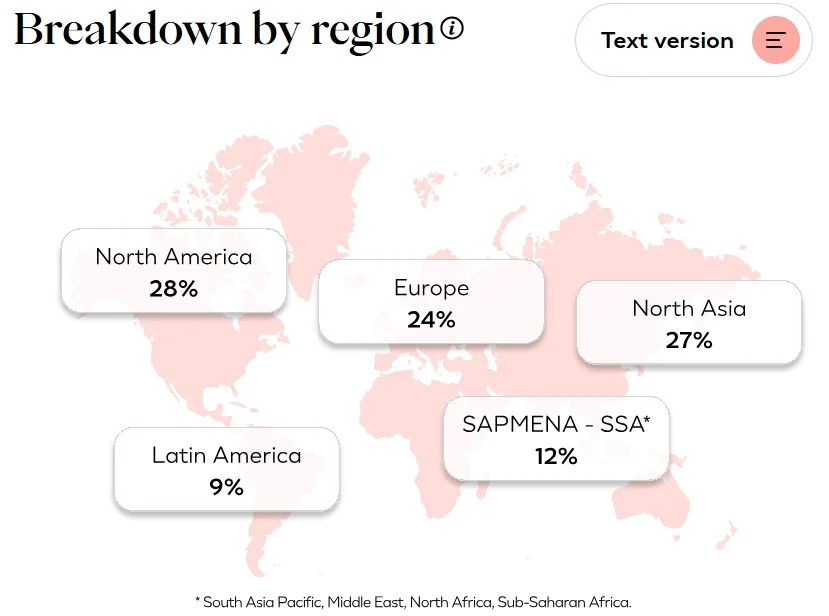
The interesting part is how close the leading regions are, and no single region owns the beauty market.
2. SAPMENA-SSA could add 380 million potential consumers by 2030
L'Oréal estimates that South Asia Pacific, the Middle East and North Africa, together with Sub-Saharan Africa, could add approximately 380 million potential consumers between 2025 and 2030.
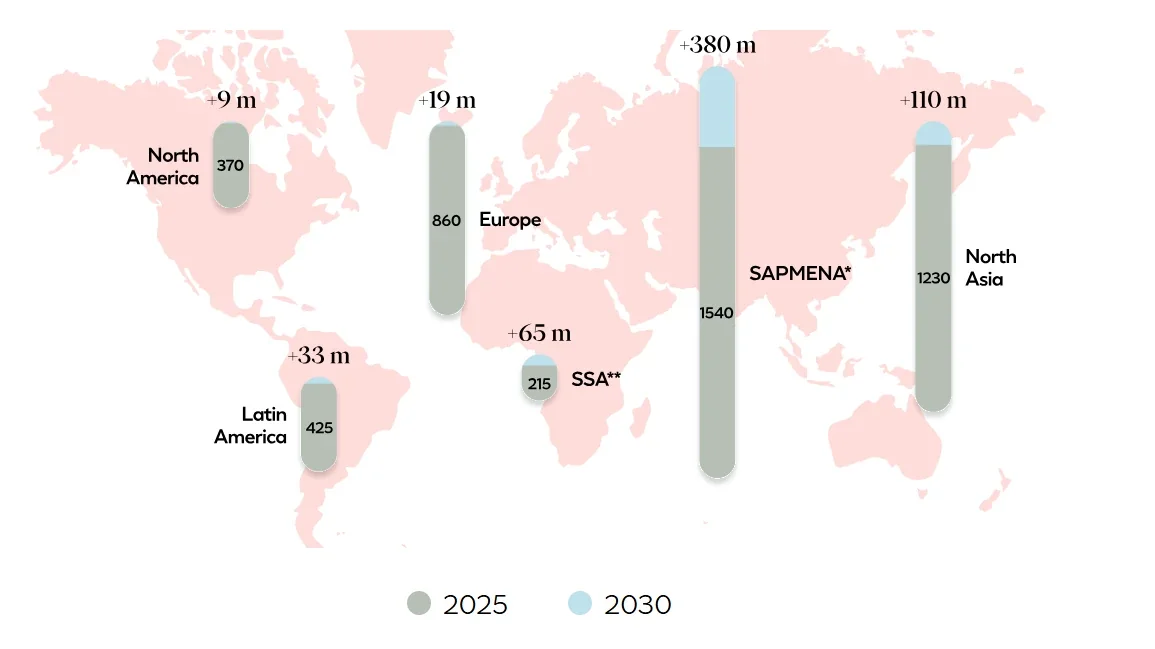
L'Oréal's beauty growth metrics are not a small emerging opportunity for mid-sized beauty brands to grow their customer base. Because there will be hundreds of millions of potential consumers entering the beauty economy.
However, with every growth opportunity, there will always be some challenges. The challenge for brands now is to adapt products and strategies to local purchasing power, routines, cultures, and distribution systems.
Such an approach will help brands stand out from those brands that are simply exporting an existing Western beauty playbook.
3. South Korea's cosmetics exports reached $11.4 billion in 2025
South Korea's cosmetics exports reached $11.4 billion in 2025, according to South Korea's Ministry of Food and Drug Safety.
This statistic is evidence that K-beauty has reached new heights in global exports, fueling the K-beauty industry. The country's cosmetics trade surplus exceeded $10 billion for the first time.
People used to think of K-beauty as a trend, but these stats have also proved that it's not just a trend, but a whole export industry.
Then AI Entered the Beauty Industry
We have all experienced the rise and impact of Artificial Intelligence in every industry boom. So, if TikTok can change how people discover products, AI can change how they decide which products are right for them.
That's particularly relevant in beauty because the category is inherently personal. We all have different skin types, hair types, and fragrance preferences; then why should our recommendations be identical?
That's where Generative AI comes into play.
1. Generative AI could create $9 billion to $10 billion in economic value for beauty
McKinsey estimates generative AI could create approximately $9 billion to $10 billion in economic value for the beauty industry.
Typical businesses use Gen AI only for customer-service chatbots, but the possibilities are countless, since it can help with product discovery, personalization, marketing, automation, consumer research, and product innovation.
Currently, as Gen AI has developed to a stage where it can do what was once considered impossible, the interesting question isn't whether beauty companies will use AI. But the question is where they will use it first.
2. Hyperpersonalized targeting could increase conversion rates by up to 40%
The same report by McKinsey estimates that hyperpersonalized targeting could improve conversion rates by as much as 40%.
When beauty brands talk about personalization, it means they can train Gen AI to give product recommendations based on consumers' skin type, hair type, shade, routine, previous purchases, or stated preferences.
But there's something that beauty businesses need to consider.
The more personal the recommendation becomes, the more consumers need to trust the system producing it. AI can make beauty recommendations in a smart way, but it doesn't automatically make them trustworthy.
This is something that you have to do for yourself, for your existence, and for winning the beauty market.
Consumers Are Asking a Different Question About “Clean” Beauty
You may have felt that the sustainability conversation also looks different when you put numbers behind it. Consumers are increasingly demanding and prioritizing sustainability in the beauty market as well.
However, brands need to clearly understand that saying sustainability matters doesn't always mean consumers are ready to pay extra. Sustainable packaging is a bit more expensive than unsustainable packaging.
That's why I think packaging is becoming a particularly interesting part of the adventure.
1. The clean beauty market is projected to reach $12.4 billion in 2026
Fortune Business Insights estimates the global clean beauty market will reach approximately $12.4 billion in 2026, with a projected CAGR of nearly 15% through 2034.
Beauty brands need to understand that "clean beauty" doesn't have a single universal definition. So I wouldn't treat every clean-beauty market forecast as directly comparable.
But the direction is clear enough for brands to understand what their target consumers are asking for. Consumers are actually paying more attention to what goes into the product itself.
They pay attention to the packaging, but it is their second priority, not the first one.
2. 74% of consumers consider sustainability important when buying makeup
GlobalData's Q4 2025 consumer research found that 74% of consumers considered sustainable or environmentally friendly attributes either essential or nice to have when buying makeup.
Even more interestingly, 73% actively seek products that reduce packaging waste, which shows that consumers are environmentally conscious.
These stats suggest a shift: simply telling people "we're sustainable" isn't enough anymore. Now, they need to establish themselves as an authority by explaining to consumers:
What exactly are you changing?
Less packaging?
Refillable packaging?
Recycled materials?
A longer-lasting product?
Businesses have to build their authority within seconds because low attention spans can cause brands to lose customers. According to Forbes, social commerce now drives 68% of the beauty market's revenue globally.
Gen Z and Gen Alpha have a very low attention span, which forces beauty brands to explain everything to them in seconds. And these are the customers who are not going to be impressed with vague sustainability claims.
At the End, I Looked at the Beauty Companies Making All This Money
After looking at categories, channels, consumers, and technology, I wanted to know what beauty companies are making the most out of beauty.
This is where another caveat arises, and it matters most:
Company revenue isn't the same thing as market share.
L'Oréal is primarily a beauty company.
P&G sells beauty alongside many other consumer categories.
Estée Lauder operates heavily in prestige beauty.
So simply ranking their total corporate revenues wouldn't tell us who "owns" beauty or which company is driving trends. Still, their reported numbers show just how large the industry's leading players have become in 2026.
1. L'Oréal generated €44.05 billion in sales in 2025
L'Oréal Finance reported that L'Oréal generated €44.05 billion in sales in 2025. Its Dermatological Beauty division grew 5.5%, while Professional Products grew 7.5%.
The size or numbers of L'Oréal weren't striking for me, but it was the diversification of the brand, from Dermatological Beauty to Professional Products.
That's what tells us: Beauty's biggest companies increasingly operate across mass-market products, luxury, professional beauty, dermatological products, and digital commerce.
2. Estée Lauder generated $14.33 billion in fiscal 2025 sales
The Estée Lauder Companies reported $14.326 billion in fiscal 2025 net sales, with an 8% drop in sales over the past year.
Its reported category sales included approximately:
$6.96 billion in skincare
$4.21 billion in makeup
$2.49 billion in fragrance
$565 million in haircare
But here's the statistic that makes the story more interesting: Estée Lauder's overall sales declined 8% from the previous year. So even inside a giant beauty industry, growth isn't guaranteed for every year.
That might be the most important lesson in this entire list.
I Understand 'Beauty is Big'
After all these numbers, I don't repeat that old phrase the same way anymore. Now, I know "Beauty is big," but it's also fragmented, fast-moving, and unevenly distributed.
Skincare dominates spending, but fragrance is quietly rising. North America got the lead this year by a hair, but not by a landslide. Gen Z is rewriting the rules on trust, discovery, and what counts as prestige beauty.
AI hasn't replaced human judgment in beauty, but it has just made personalization the new baseline expectation.
In the end, I found the real meaning behind "beauty is a big business": a brand like Estée Lauder has to earn growth every year. This is what every brand should know and understand so it can struggle better to grow.