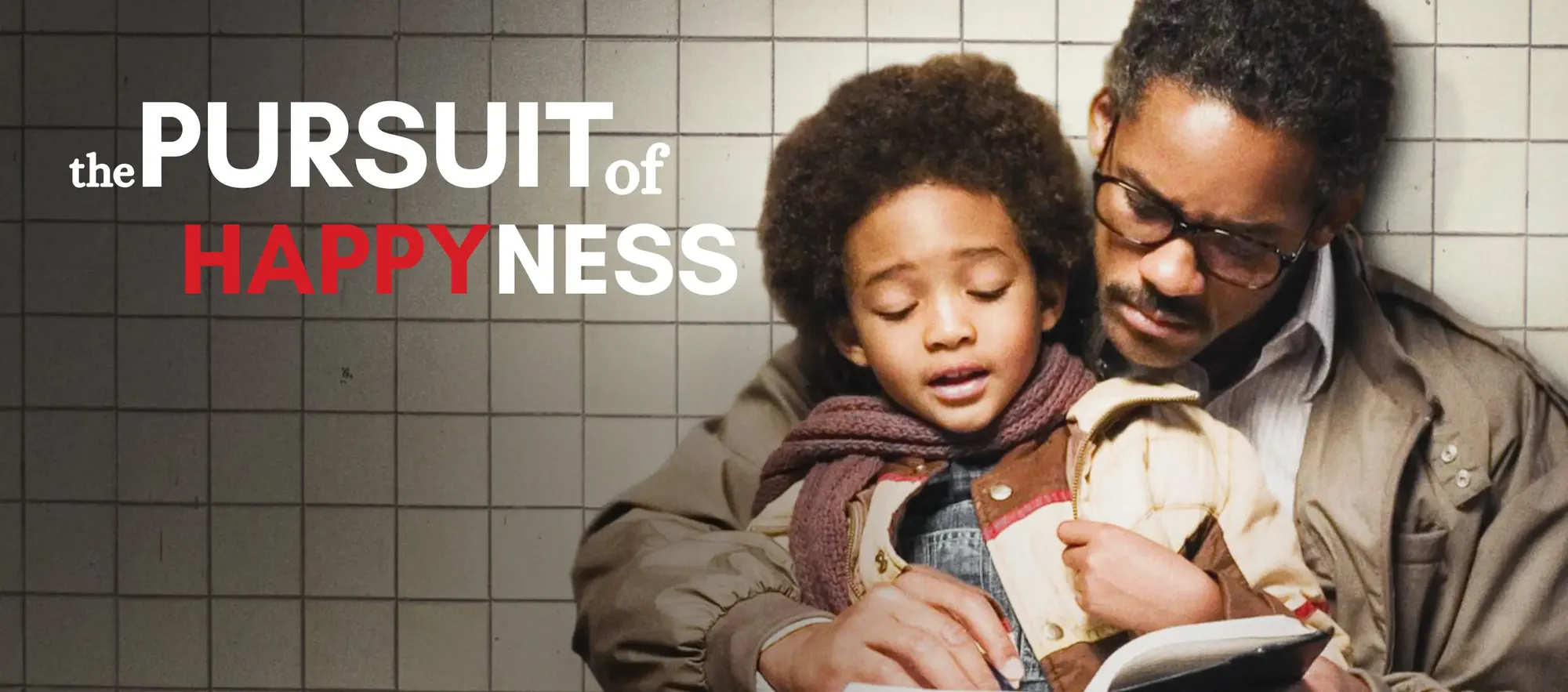
I don't watch movies only for entertainment purposes, but I take inspiration from them. And when the movie is based on a true story, then I feel like I dig up a treasure. The Pursuit of Happyness is that kind of movie for me.
It was released in 2006, directed by Gabriele Muccino, and it follows an original story of Chris Gardner. Will Smith played Chris Gardner, who was a struggling salesman trying to build a better life for himself and his young son, Christopher.
His life gradually falls apart; his marriage breaks down, his apartment is lost, and eventually the father and the son are homeless. Somehow, he gets an opportunity for an unpaid internship at a prestigious stock brokerage firm.
The beauty of the movie lies in Chris's struggles to make his life better and move on from situations. And that is where the movie became more philosophical for me.
The Philosophy I Understand from The Pursuit of Happyness
Arthur Schopenhauer had a famously pessimistic view of existence. In his philosophy, bringing another human being into a world filled with suffering can itself be questioned.
If life inevitably contains pain, disappointment, illness, loss, and death, why voluntarily bring someone into it?
However, the movie doesn't answer Schopenhauer directly, but it does something more interesting. It showcases a father who knows the difficulties of life, yet he believes that giving his child a chance to experience life is worth fighting for.
Chris doesn't know that his son will have a better tomorrow, but what he knows is that if you try to create an opportunity, there will be possibilities an opportunity will be created.
That distinction really does matter for a struggling father.
The movie's argument is not really that life becomes permanently happy once you become successful. It is that the possibility of a better life can itself become a reason to keep living, loving, and trying.
And perhaps that is why the film hit me harder than I expected.
The Story of The Pursuit of Happyness (2006)
You may have gotten an idea about the story of this movie from my previous section. However, I've written a clear summary of the movie for you if you want to have an idea before investing your time to watch it.
Chris Gardner is a salesman struggling to make money by selling portable bone-density scanners. The machines are expensive, difficult to sell, and, despite Chris believing in them, do not provide the financial security his family needs.
His wife Linda is exhausted by their financial problems. Eventually, she leaves Chris and their son Christopher, leaving Chris with the responsibility of raising his child while trying to survive.
Then Chris notices an opportunity.
He meets a successful stockbroker and becomes fascinated by the possibility of becoming a stockbroker himself. He manages to secure an internship at Dean Witter Reynolds, but there is a catch: the internship is unpaid. Only one intern out of the group will ultimately receive the job.
For someone who is already struggling to pay rent, an unpaid internship sounds almost impossible.
But Chris accepts it anyway.
Soon, he and Christopher are evicted from their apartment. They move between homeless shelters, friends' homes, and increasingly desperate places to sleep. At one point, Chris has to spend the night with his son inside a subway station bathroom.
The irony is brutal. Chris is working toward a better future while barely surviving the present.
Yet he keeps going.
He sells his remaining scanners. He studies. He makes phone calls. He tries to impress his managers. He races across San Francisco trying to make enough money and still be there for his son.
The movie compresses and dramatizes Gardner's real experience, but its central struggle comes from his actual period of homelessness and his attempt to build a career in finance.
The Cast of The Pursuit of Happyness
The movie itself is a gem, and the casting director put everything in place by casting the best talent into it. Here is the cast of the movie:
Will Smith as Chris Gardner: The emotional center of the movie. Smith plays Chris as a man who is desperate without becoming pathetic, optimistic without becoming unrealistically cheerful.
Jaden Smith as Christopher: Will Smith's real-life son makes his film debut as Chris's young son. Their real father-son relationship gives many scenes an unusual intimacy.
Thandiwe Newton as Linda: Chris's partner, overwhelmed by their financial situation and eventually leaving the family.
Brian Howe as Jay Twistle: The Dean Witter manager who becomes an important figure in Chris's attempt to enter the brokerage business.
James Karen as Martin Frohm: One of the senior figures at the brokerage firm.
Dan Castellaneta as Alan Frakesh: Another employee at the brokerage firm.
Will Smith was also nominated for the Academy Award for Best Actor for his performance.
The Pursuit of Happyness Trivia and Questions
Here are some of the social trivia and answer-worthy questions about this movie:
The movie has a runtime of 1 hour and 57 minutes, or 117 minutes. It was released in the United States on December 15, 2006.
Spoiler warning: The movie ends with Chris finally receiving the job he has been fighting for.
After months of homelessness, financial desperation, and the unpaid internship, Chris is called into a meeting with the company's executives. He is told that he has been selected for the position.
Chris struggles to contain his emotions. He walks out of the office, looks at the people around him, and silently celebrates the moment.
The film then reveals that the real Chris Gardner is walking through the crowd.
It is a simple ending, but that is exactly why it works. There is no giant celebration or exaggerated speech. After everything Chris and his son have endured, simply getting the job feels enormous.
What is the moral of The Pursuit of Happyness?
The obvious lesson is persistence.
But I think the movie offers something more complicated than "work hard and you will succeed."
Chris works extremely hard, but the movie also shows how fragile financial security can be. Hard work does not automatically guarantee success. Chris is fortunate enough to encounter an opportunity, recognize it, and fight desperately to make something out of it.
The deeper moral is: "You cannot control every circumstance in life, but you can decide whether to keep pursuing the possibility of something better."
Every Peak Moment of The Pursuit of Happyness Reviewed
I ranked some of the peak moments of The Pursuit of Happyness that hit me deep in my heart.
1. Chris realizes he can become a stockbroker
One of the most important moments happens when Chris sees the possibility of becoming a stockbroker.

Until this point, he is essentially trying to survive through a product he believes can make him money. Suddenly, he sees another path.
What I like about this moment is that Chris does not discover a magical solution. He discovers a difficult one.
He knows the internship will be unpaid. He knows competition will be brutal. Yet he also understands that continuing exactly as he is will probably lead nowhere.
Sometimes hope is not about finding an easy road. It is about finding a road that is difficult but actually leads somewhere.
2. Chris loses his apartment
The eviction scene is where the movie stops feeling like a conventional inspirational story and becomes genuinely painful.
Chris has a child. He has responsibilities. He is trying to improve his situation, yet his circumstances keep getting worse.
There is something especially cruel about watching someone work toward stability while simultaneously losing the basic things that stability requires.
The movie does not allow Chris to fail privately. His son experiences the consequences with him.
3. Chris runs after the stolen scanner
One of the most memorable sequences is Chris chasing after someone who has taken one of his bone-density scanners.
It looks almost absurd. A grown man running through the streets after a piece of equipment. But the scanner represents much more than a product.
It represents rent. Food. His son's future. His last remaining opportunity to make money.
Chris running after it is essentially Chris running after his life.
4. The internship interview
Chris arrives at his interview looking completely unprepared by conventional standards.
He has been painting his apartment, dealing with financial problems, and sleeping in increasingly desperate conditions. Yet he still walks into the interview and tries to make the best possible impression.
The scene works because Chris does not pretend that everything is fine. He admits the truth.
And somehow, that honesty becomes part of what makes him memorable.
5. The basketball conversation with Christopher
This is probably one of the most important scenes in the entire film.
Christopher wants to become a professional basketball player. Chris initially tells him that he probably will not become one because he was not particularly good at basketball himself.
Then he realizes what he has done. He tells Christopher not to let anyone tell him that he cannot do something. Not even his father.
This scene is important because Chris is not simply teaching his son to dream.
He is teaching him to protect his dreams from other people's limitations.
6. The bathroom scene
The subway bathroom scene is one of the hardest moments to watch. Chris and Christopher have nowhere to go. He locks the bathroom door and tries to create a safe space for his son while people outside continue using the station.
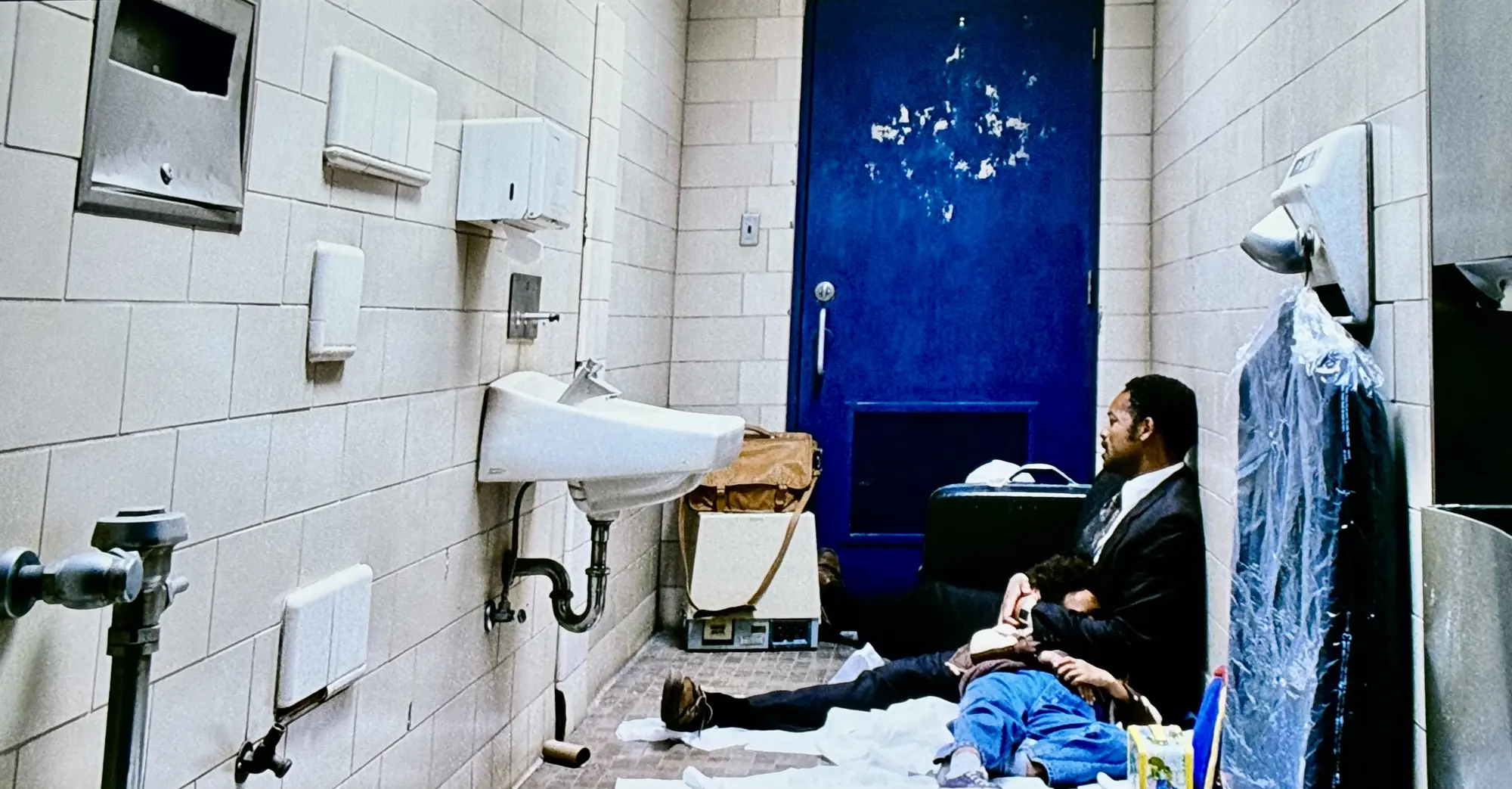
Christopher does not fully understand the horror of their situation, but his father does, which makes the scene devastating.
He is not only trying to survive homelessness. He is trying to prevent his child from feeling completely abandoned by the world.
7. The final interview
The final interview is powerful because Chris has almost nothing left to prove except himself. He has survived the worst period of his life while maintaining his responsibilities as a father.
And when he finally hears that he has been selected, the emotion feels earned. The movie does not present success as a trophy, but it presents success as relief.
That is a much more honest emotion.
What The Pursuit of Happyness Really Says About Life
This is where the movie became unexpectedly philosophical for me.
Schopenhauer's pessimism asks us to look at life honestly. Human existence contains suffering, and having children means bringing another person into that complicated existence.
Chris Gardner's story does not disprove that. In fact, the movie spends nearly two hours showing us how painful life can become. A child can mean responsibility.
A family can mean financial pressure. Love can create vulnerability. Parenthood can give you something you are terrified to lose. And yet Chris's relationship with Christopher is also the thing that gives his struggle meaning.
That is the paradox I took from the film.
The same life that contains suffering can also contain reasons to endure it.
Christopher does not make Chris's life easier. In many practical ways, having a child makes Chris's situation harder. He has another person to feed, protect, and shelter.
But Christopher also gives Chris a reason not to give up.
That does not necessarily mean that suffering is good or that having children is automatically worth it. I don't think the movie proves something that universal.
Instead, it presents one man's answer.
Chris chooses to believe that the possibility of giving his son a better life is worth everything he has to endure to get there.
And when he finally succeeds, the reward is not simply money.
It is the knowledge that all those terrible days did not define the rest of their lives.
That, to me, is the real "happyness" the movie is pursuing. You can also read my other film review of How to Lose a Guy in 10 Days.