Elia Raza
← All posts
Movies - I WatchOct 24, 20268 min read

Sunk with Titanic in 1997.

This movie's story isn't about the RMC Titanic, but Life.

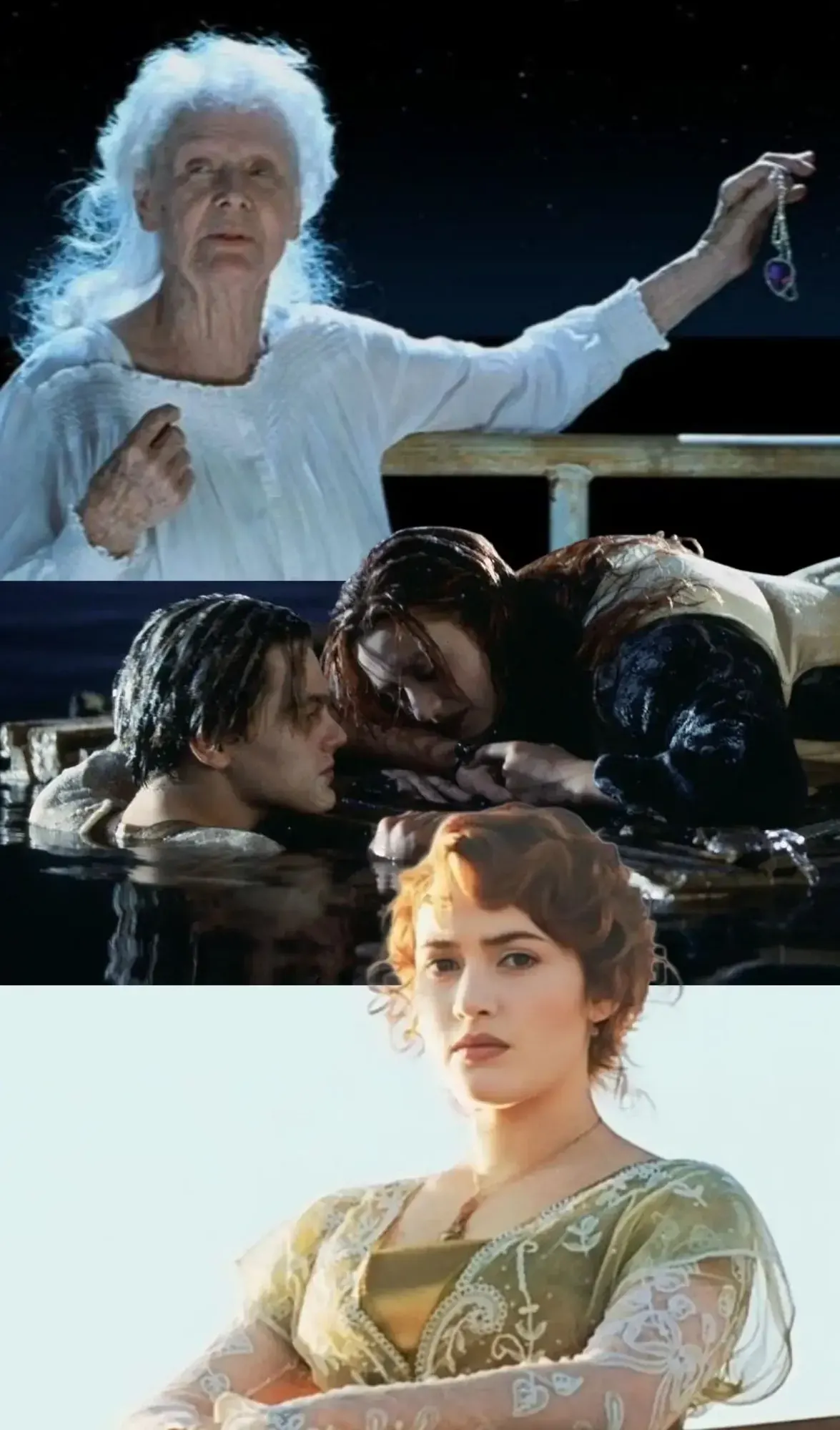
Rose DeWitt Bukater Calvert, Jack Dawson, and Rose DeWitt Bukater are depicted in a three-panel vertical collage from the 1997 film Titanic. The top panel shows an elderly Rose in a white nightgown standing at the ship's railing at night, holding up the Heart of the Ocean necklace. The middle panel shows a freezing Jack in the dark water looking up at a young Rose, who is lying on a floating wooden door. The bottom panel shows a close-up of a young Rose looking directly ahead on the sunny deck of the ship.
Memories of love and loss aboard the Titanic. — eliaraza.com
Elia’s Rating
5 / 5

You Should Watch It.

Directed by
James Cameron
Written by
James Cameron
Starring
Leonardo DiCaprio, Kate Winslet, Billy Zane
Genre
RomanceCostume DramaDark ComedyPsychological Drama
Released
1997 · United States
Runtime
3h 14m
Rated
PG-13
Language
English
IMDb
8.0 / 10

I still remember the first time the ship broke in half on screen while I wished them a happy ever after. Now, everything I ask for feels childish.

James Cameron wrote Jake in a way to sacrifice him for Rose to understand what really life meant to live. Jake was the one who saved Rose first from suicide, then from her toxic engagement, and gave her a reason to live. RMS Titanic isn't the main theme of the film because there are dozens of other movies on Titanic; Cameron's Titanic discusses life.

How?

That's my own perspective on the movie that I found amazing and interesting. Thereby, I'm going to share my review on 29 years old movie Titanic. You will find a 46,000-ton vessel standing nearly vertical in the North Atlantic while people slid screaming into the dark.

The Movie Titanic's Setup

In 1996, treasure hunter Brock Lovett (Bill Paxton) is diving the wreck of the Titanic to look for a diamond necklace called the Heart of the Ocean.
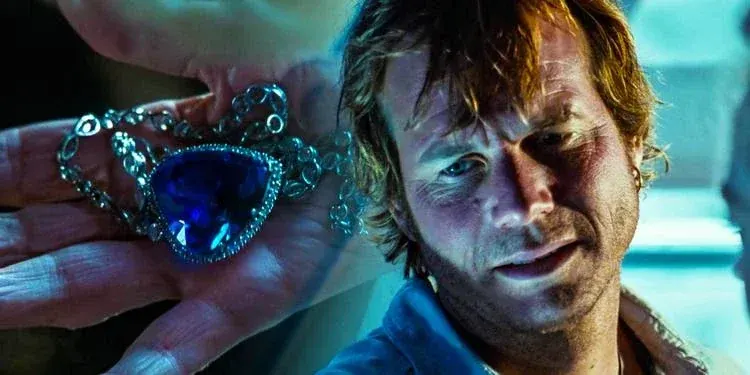
An older hand holds a large, heart-shaped blue diamond necklace—the famous Heart of the Ocean—surrounded by smaller diamonds on a silver chain, while a close-up overlay on the right shows a weathered, sun-bronzed man looking downward with a mixture of fatigue and deep contemplation. The man, a rugged treasure hunter with messy, damp brown hair, a hint of stubble, and an earring, is illuminated by an eerie, cool blue light that highlights the intense, searching look in his eyes against a blurred, clinical background.
Bill Paxton Aside The Heart of the Ocean Diamond.

Instead, he finds a nude sketch of a young woman wearing that necklace. The drawing brings 101-year-old Rose Dawson Calvert (Gloria Stuart) to the surface of the modern story, who was really there, and the one who had the Heart of the Ocean.

What follows is her memory of the ship’s maiden voyage in April 1912. Seventeen-year-old Rose DeWitt Bukater (Kate Winslet) is a first-class passenger sailing toward a marriage she does not want, locked into an engagement with the arrogant, controlling Cal Hockley (Billy Zane).
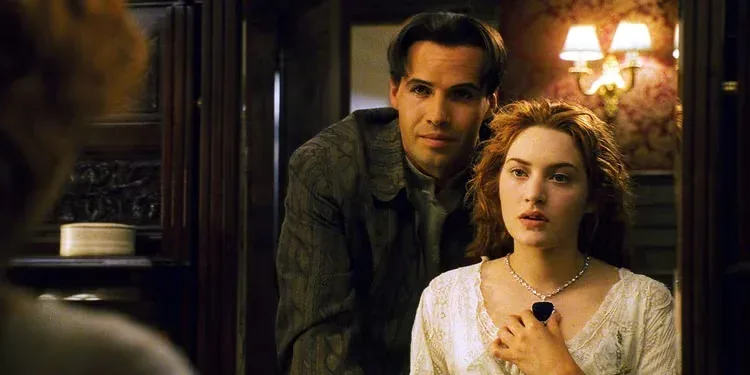
A medium cinematic shot from the 1997 film Titanic featuring two characters standing inside a wood-paneled stateroom. On the right, Rose DeWitt Bukater, played by Kate Winslet, is depicted from the waist up. She has fair skin, wavy reddish-brown hair parted down the middle, and a look of quiet apprehension. She wears a white, delicate lace-trimmed dress and a prominent white gold or platinum necklace featuring a large, heart-shaped blue diamond pendant—the Heart of the Ocean—which she holds lightly with her right hand. Standing closely behind her shoulder is Caledon "Cal" Hockley, played by Billy Zane. He is a clean-shaven man with dark, slicked-back hair, looking directly toward the left side of the frame with a subtle, confident smile. He wears a dark, patterned grey coat over a high-collared light shirt. The background consists of rich, dark wood doors and paneling, with an ornate gold sconce lamp glowing softly against a red patterned wallpaper on the right. In the blurred foreground on the far left, the back of another character's head is partially visible.
Kate Winslet and Billy Zane in a scene from Titanic. Paramount Pictures

Her mother Ruth (Frances Fisher) has made it clear that the family’s money is gone and this marriage is the only way to keep their social position. Rose was going to jump off the ship in the night to end her life, and there Jack Dawson (Leonardo DiCaprio), a penniless artist who won his third-class ticket in a poker game, saved her.
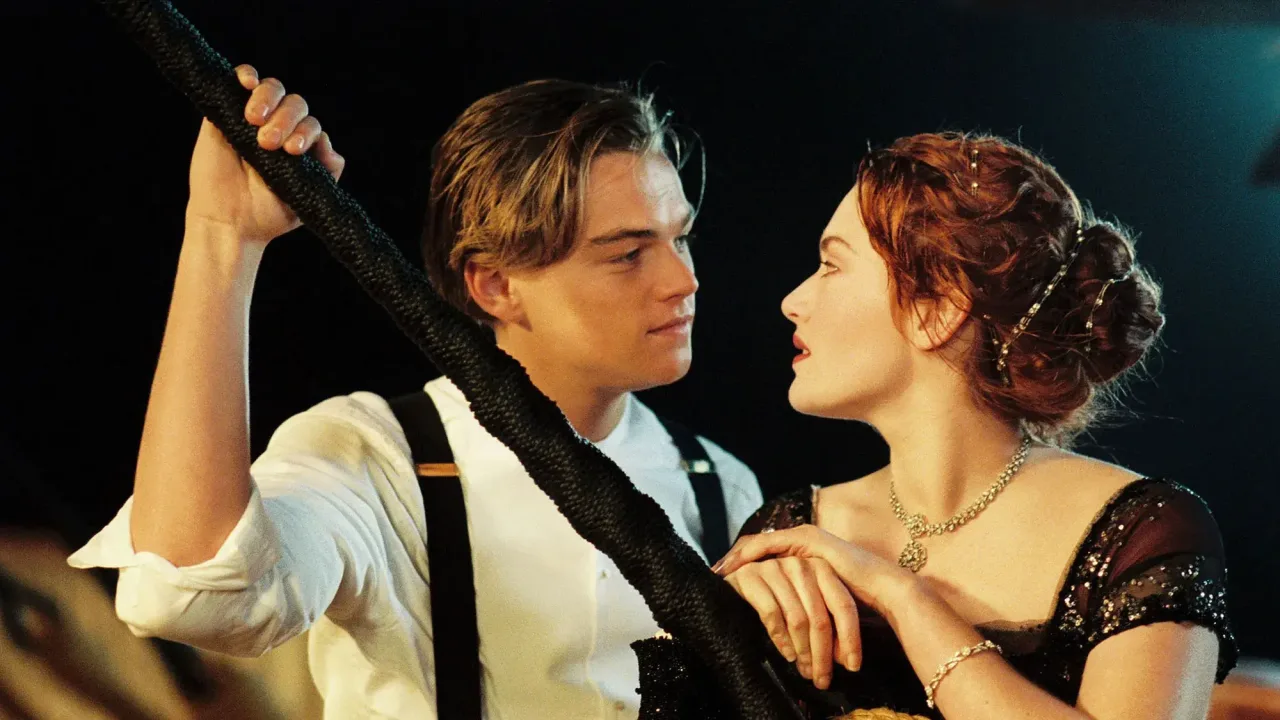
A medium shot captures Jack Dawson, played by Leonardo DiCaprio, and Rose DeWitt Bukater, played by Kate Winslet, looking intensely into each other's eyes against a dark night background on the deck of the ship. On the left, Jack is depicted from the waist up with light brown, side-parted hair with a few strands falling over his forehead, wearing a white button-down shirt with rolled-up sleeves and black suspenders. His right arm is raised, gripping a thick, dark, textured rope or post that slices diagonally through the frame. On the right, Rose is seen in profile from the chest up, her red hair styled in an elegant updo secured with a silver jeweled hairpiece. She wears an exquisite black evening gown with sheer cap sleeves detailed with glittering beadwork, a delicate silver rhinestone collar necklace, and a matching bracelet on her left wrist, which rests gently near Jack. The lighting highlights their facial features and creates a romantic, intimate atmosphere.
Leonardo DiCaprio and Kate Winslet in a frame. Paramount Pictures

After their interaction, they fall in love. Rose's elite class doesn't let her do things she wants to, but Jack takes her to the third-class, where they dance and realize what relationship has been developing since they met. The rest you know: ship hits an iceberg, Rose saves Jack, and at the end Jack saves Rose.

Cameron structures the film with unusual intelligence. The modern framing device—complete with a computer simulation of the sinking—does the heavy lifting of explaining the technical details so that when the disaster arrives, the audience already understands the sequence of failures. We don’t need a character to stop and lecture us about the rivets or the watertight compartments. We already know. That frees the second half of the movie to focus almost entirely on human behavior under extreme pressure.

Nearly three decades later, the film remains a strange, magnificent hybrid: part meticulous historical recreation, part shameless Hollywood melodrama, part technical miracle. It is both the most expensive movie ever made at the time and one of the most purely emotional experiences the multiplex has ever delivered.

If you’ve never seen it, or if you only know it through the endless “My Heart Will Go On” memes and the “draw me like one of your French girls” jokes, you might be surprised by how much of it still works, and how hard some of it still hits.
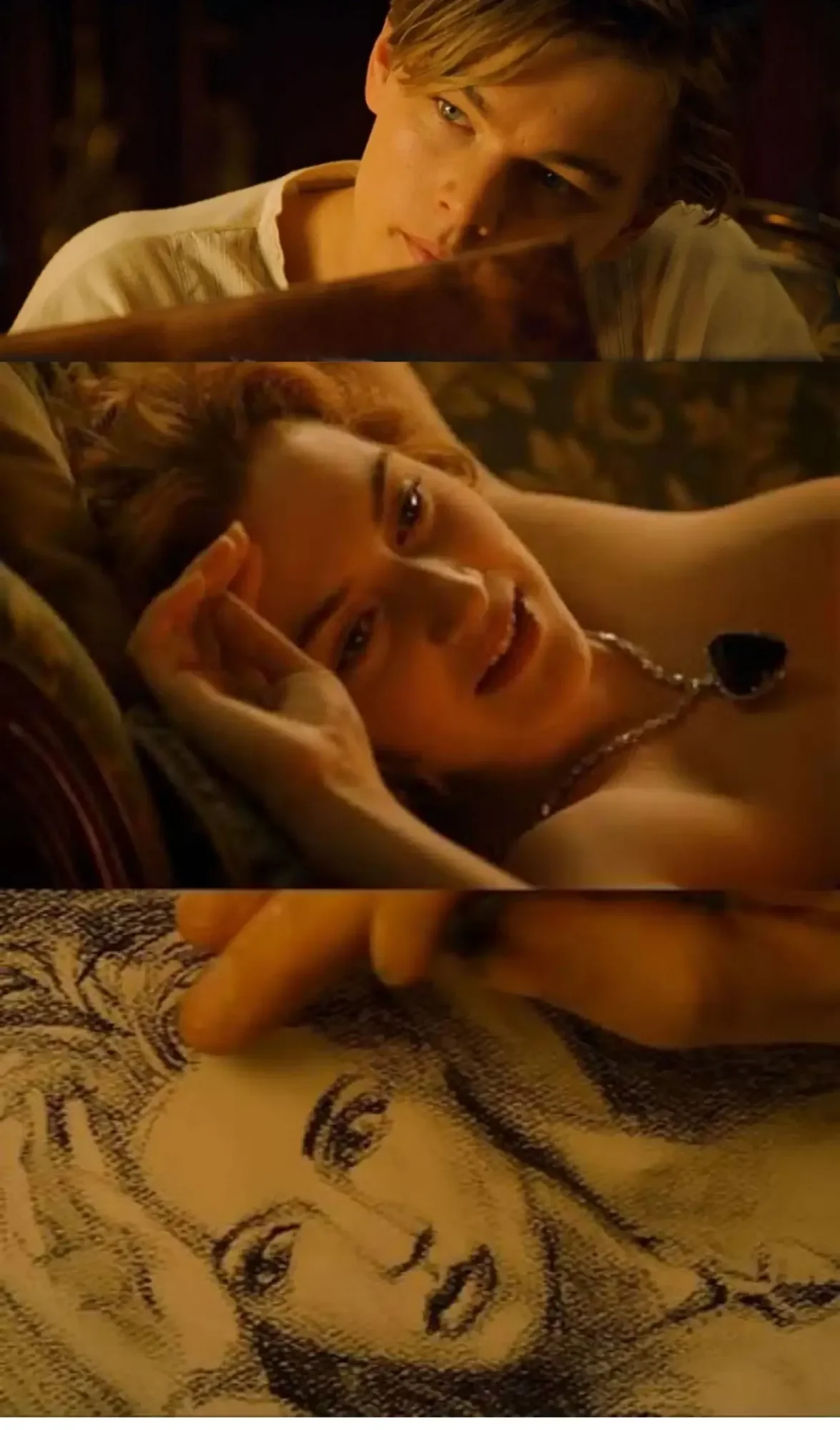
A detailed three-panel vertical composite image from the iconic 1997 romantic drama film Titanic captures the memorable sketching sequence. In the top panel, Leonardo DiCaprio, portraying the bohemian artist Jack Dawson, gazes intently forward with a focused, artistic expression as he holds up a drawing board. The middle panel shows Kate Winslet, portraying the aristocratic Rose DeWitt Bukater, reclining gracefully on a plush couch in a relaxed posture while wearing the famous Heart of the Ocean sapphire necklace around her neck. The bottom panel provides a close-up perspective of a hand gently smudging charcoal onto textured paper, capturing the emerging, expressive portrait sketch of Rose as she poses during the scene.
Draw Me Like Your French Girls Scene from Titanic. Paramount Pictures

Performances That Still Hold

Kate Winslet is extraordinary. At 22, she somehow projects both the brittle polish of a young Edwardian socialite and the raw, rebellious intelligence underneath. Her Rose is not a passive romantic heroine, but she is trapped, angry, and increasingly willing to burn her life down for a few days of actual freedom.

The famous “I’m flying” moment on the bow works because Winslet sells the sudden, giddy release of it. You believe this woman has never felt the wind in her face without someone telling her to stand up straight.
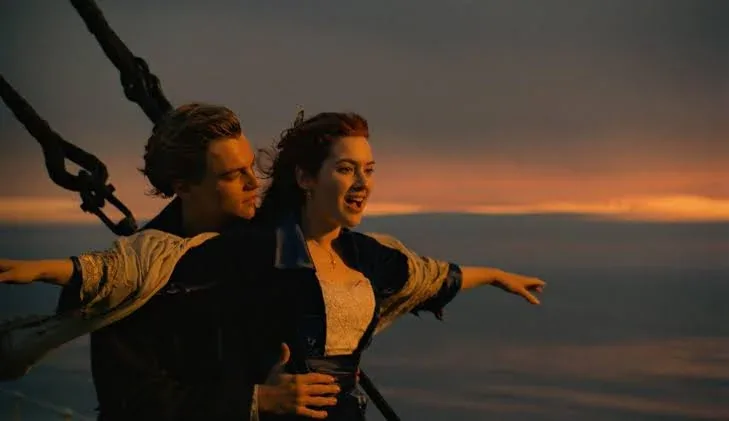
A cinematic medium shot from the 1997 film Titanic featuring Jack Dawson (played by Leonardo DiCaprio) and Rose DeWitt Bukater (played by Kate Winslet) at the bow of the ship during a vibrant orange and golden sunset over the ocean. Rose stands at the very edge with her arms extended wide, smiling with open-mouthed awe and exhilaration. Her red hair blows back in the wind, and she wears a dark blue velvet coat over a white lace dress. Jack stands closely behind her, holding her securely by her waist with one hand while stretching his other arm out parallel to hers. He looks at her affectionately with a soft smile. Large, dark metal rigging ropes and cables anchor into the frame on the left, cutting diagonally against the glowing horizon line where the orange sunset meets the dark, calm sea below.
Titanic (1997) "I'm Flying" Scene. Paramount Pictures

Leonardo DiCaprio, then 22 and still riding the afterglow of Romeo & Juliet, brings a loose, charismatic energy that keeps Jack from becoming pure fantasy. Jack is, by design, a bit of a romantic ideal—the free spirit who teaches the rich girl how to spit and dance and live, but DiCaprio plays him with enough humor and heat that you never quite roll your eyes.

Their chemistry is the real special effect. When they lock eyes across the first-class dining room or share that stolen moment in the cargo hold, the class barriers feel temporary, and the iceberg feels inevitable.
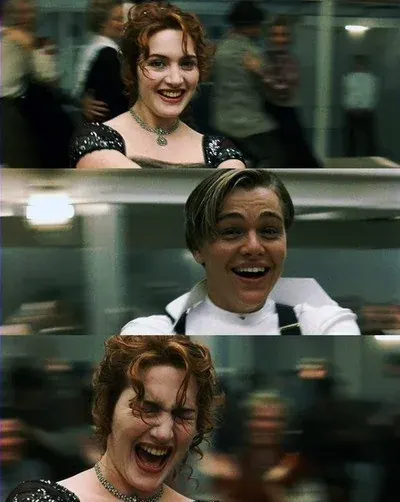
A three-panel vertical collage from the 1997 film Titanic features Rose DeWitt Bukater, played by Kate Winslet, and Jack Dawson, played by Leonardo DiCaprio, spinning joyfully during the third-class party scene. In the top panel, Kate Winslet as Rose grins widely at the camera, wearing an elegant black beaded dress and a silver necklace, her red hair styled in loose curls. The middle panel captures a laughing Leonardo DiCaprio as Jack, looking upward with wide eyes and an open smile, wearing a white shirt with suspenders. The bottom panel shows a close-up of Rose laughing uproariously with her eyes tightly shut as they spin rapidly, creating a motion blur in the background.
Jack and Rose spinning and laughing during the energetic third-class party scene. Paramount Pictures

Billy Zane has the thankless job of playing pure privilege and still manages to make Cal more than a cartoon. There is a late moment, during the evacuation, when the mask slips and you see something almost human.

Kathy Bates, as the “Unsinkable” Molly Brown, steals every scene she’s in with pure, earthy force. Gloria Stuart, in her Oscar-nominated supporting turn as the elderly Rose, gives the framing story a quiet dignity that keeps the whole enterprise from tipping into pure soap.

The Craft of the Thing

Cameron spent roughly $200 million (a staggering sum in 1997), and it is all on the screen. The production design by Peter Lamont is obsessive. The first-class dining room, the grand staircase, the steerage dance, the boiler rooms, everything feels lived-in and specific.

Russell Carpenter’s cinematography captures both the golden-hour romance of the early voyage and the blue-black nightmare of the sinking with equal authority. James Horner’s score, with its Celtic-tinged melodies and the now-inescapable Celine Dion ballad, does exactly what it needs to do: it makes the emotion bigger without apology.
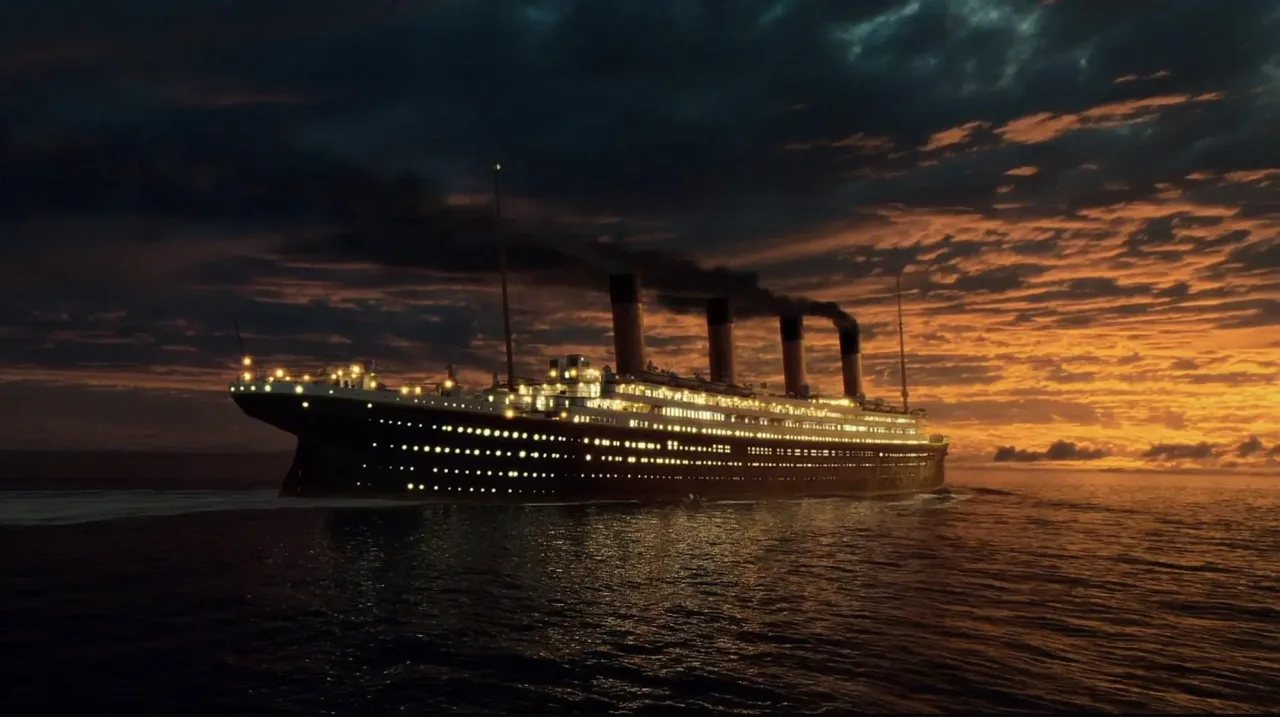
A large passenger liner, resembling the RMS Titanic, sails across a wide, calm ocean at sunset. The ship is captured from a slightly elevated side profile as it moves from left to right. It features a dark hull with rows of brightly illuminated portholes and windows casting a golden glow onto the dark water. Four large, dark funnels rise from the deck, emitting faint trails of dark smoke that drift back against a dramatic sky filled with scattered, orange-and-gold-tinged clouds. The setting sun low on the right horizon paints the sky and sea with warm, vibrant hues of orange, yellow, and deep amber, contrasting with the dark blue and gray storm clouds gathering above.
RMS Titanic sailing at sunset. Paramount Pictures

The sinking sequence remains one of the most impressive pieces of large-scale filmmaking ever committed to celluloid. Practical sets, miniatures, and then-cutting-edge CGI blend so seamlessly that even now, when digital water has become routine, the physical weight of the disaster feels real.

The ship doesn’t just sink, but dies. The final plunge of the stern, the people falling, the sudden silence after the last cry, Cameron stages it with a kind of brutal poetry.

Where The Movie Stumbles

The dialogue is frequently terrible. “I am the king of the world!” “A woman’s heart is a deep ocean of secrets.” Jack’s entire philosophy can be reduced to “make every day count,” which is the kind of fortune-cookie wisdom that would get you laughed out of a sophomore creative writing workshop.
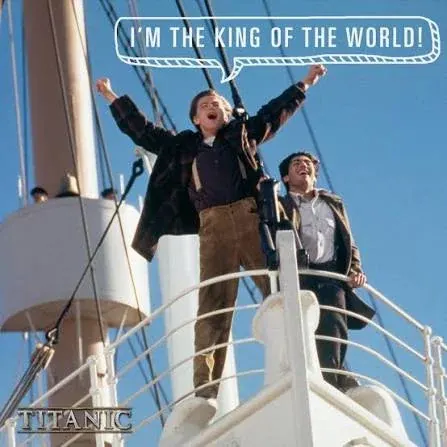
A film still from the 1997 movie Titanic captures a joyful moment at the bow of the ship against a bright, clear blue sky. Leonardo DiCaprio, portraying Jack Dawson, stands balanced at the very edge of the white prow with his arms raised wide and fists clenched in triumph. He wears a dark plaid open jacket over a purple shirt with brown suspenders and tan corduroy trousers, his mouth wide open as he shouts. A stylized white speech bubble above him reads, "I'M THE KING OF THE WORLD!". Standing just behind him to his right is Danny Nucci, playing Fabrizio De Rossi, who leans against the white metal railing. Fabrizio wears a brown coat over a white collared shirt and dark trousers, looking up with a wide, ecstatic grin. The metallic film logo "TITANIC" is positioned in the bottom left corner, while rigging lines and a large cream-colored ship mast rise into the upper left background.
Leonardo DiCaprio and Danny Nucci celebrating at the bow of the ship. Paramount Pictures

Cameron has never been a great writer of human conversation, and Titanic is no exception. The romance moves at the speed of plot necessity rather than organic development. Jack and Rose fall in love in what feels like 36 hours of screen time, and some of the supporting characters exist mostly to represent social types.

There is also a certain shamelessness to the melodrama that some viewers still find hard to swallow. The film wants you to cry, and it is not subtle about the methods it uses to get there. If you are allergic to that particular brand of Hollywood emotion, large stretches of Titanic will feel like being trapped in an elevator with someone playing the violin at full volume.

Themes That Linger

Underneath the romance and the spectacle sits a surprisingly sharp class critique. The ship is a floating microcosm of Edwardian society, and the sinking exposes every fault line. First-class passengers get lifeboats. Third-class passengers get locked behind gates. The “women and children first” rule is enforced selectively.
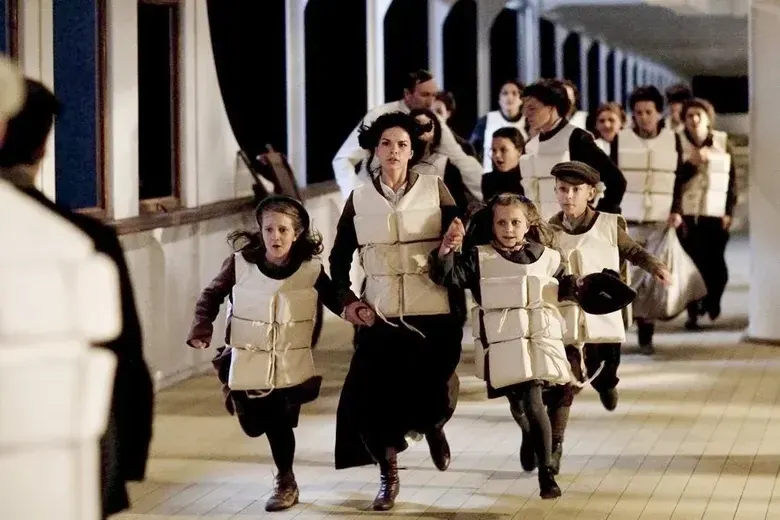
A group of actors, including a mother and three children wearing early 20th-century clothing and bulky white canvas life jackets, run in a panic down the illuminated outdoor wooden deck of a large ship at night.
Women and Children First Scene. Paramount Pictures

Cameron doesn’t lecture, but he doesn’t look away either. The image of the band playing as the deck tilts, the look on Thomas Andrews’ face as he realizes what his creation has become, the quiet dignity of the elderly couple who choose to stay in bed rather than fight for a place in a boat—these moments carry more weight than any speech.

The film is also, in its strange way, about memory and survival. Old Rose’s decision at the end, what she does with the Heart of the Ocean, is one of the more interesting choices in the entire movie. It is not the decision a purely sentimental film would make.

A medium shot captures elderly Rose Dawson Calvert, portrayed by actress Gloria Stuart, standing on the deck of a research vessel at night in a scene from James Cameron's 1997 film Titanic. She has long, voluminous white hair styled loosely back and wears a white, textured nightgown with smocking across the chest. She extends her left arm to the side, holding the "Heart of the Ocean" necklace—a large, heart-shaped blue diamond pendant on a silver chain—dangling delicately from her fingers over the dark ocean water. Her expression is solemn and reflective, with her lips slightly parted as she prepares to drop the precious heirloom into the sea, while her right hand is held close to her chest.
Gloria Stuart as elderly Rose. Paramount Pictures

Who Should Watch It in 2026

If you’ve never seen Titanic on a big screen (or at least a big television), do that. The scale is part of the point. If you only know it as “that movie teenage girls cried over in 1998,” you may be surprised by how much craft and historical detail is actually there.

If you are a pure cynic who cannot tolerate a love story that wears its heart on its sleeve, you will probably still admire the technical achievement while rolling your eyes at the romance.

Is it a perfect film? No. Is it one of the last true Hollywood epics, like the kind of movie that felt like an event rather than content?

Absolutely. Cameron set out to make the most expensive, most ambitious, most emotionally direct spectacle he could, and he largely succeeded. The ship still sinks. The people still die. And somewhere in the wreckage, a young woman learns what it means to choose her own life, even if only for a few days.

Twenty-nine years later, that still feels like something worth remembering.

5 / 5
Share

Fight Me in the Comments

Agree, disagree, or tell me I have zero taste. Speak about your feelings, just don’t be a jerk.

Spoilers? Warn people first.
Next reviewSee, "The Theory of Everything" Doesn't Tell You Everything.→